

Hawai'i, the fiftieth state, has a storied juxtaposition of politics with scenery befitting paradise found. Grover Cleveland's American business interests and political plotters engineered a faux crisis to rip the reigns of power away from Queen Liliʻuokalani late in the nineteenth century. The American Florentine style of the Iolani Palace is one of its unique charms along with the first World Heritage Site in the islands, Hawaii Volcanoes National Park.
The new president of the United States was born in Hawaii. The current governor of the state is a republican along with the outgoing president of the United States. The Papahanaumokuakea Marine National Monument received President George W. Bush ministrations to set it up as a UNESCO WHS alongside the recently refurbished visitor's museum of Mount Vernon on the mainland, in Virginia. Bush created the monument of islands and waters in Northwestern Hawaii in 2006. A decade and a half has elapsed since the last US offering to get on the prestigious list. Now the pristine Pacific Marine Park along with the Mariana Trench and the Rose Atoll near American Samoa spread out for 50 nautical miles in each direction.

Native Hawaiian fisherman William Aila said the UNESCO designation for the Papahanaumokuakea Marine National Monument has both natural history and cultural value. The designation would "put it on a much higher pedestal in terms of importance to the world." (James Maragos, U.S.. FISH AND WILDLIFE SERVICE)The Monument and the miles of Pacific Ocean it covers would be a first marine entrant for the coveted status. The ecosystems and range of marine life encompasses more than 7,000 different species, the largest albatross colony on the planet and the 23 endangered or threatened species including the habitats of the monk seal and green turtles are markers enhancing the application. The entire process takes eighteen months seeping one of the rare good tokens of Bush environmental legacy well into a President Obama's first term. Hawaii is currently suffering a steep decline in tourism which could also be helped and hurt with a WHS moniker in rare areas where 14 million birds call home. The unspoiled beauty is what makes it so valuable now as the new park legally bans commercial fishing and mining in the exclusive economic zone.
Papahanaumokuakea is being nominated as a “mixed” site (for both itsnatural and cultural resource values) because of its unique geology, ecology, biology, Native Hawaiian cultural heritage, and its significance to the world.
Native Hawaiians view the Northwestern Hawaiian Islands (NWHI) as an integral part of the archipelago and a deeply spiritual location.

Physical remnants of wahi kupuna (ancestral places) and oral traditions provide evidence of the various past uses of the islands and surrounding ocean by Native Hawaiians both as a home and a place of worship.
 What a beautiful part of the world with a range of political viewpoints melding together to work together to garner the seal that graces less than 1000 sites on Earth. It is truly the embodiment of the spirit of Hawai'i.
Mahalo & Aloha.
 For major weather emergencies, Cuba's government mercilessly evacuates hundreds of thousands of people out of the way, under threat of guns if required. This summer,all over the island, Cuban citizens were on multiple forced migrations as hurricane after hurricane flooded the Caribbean's largest island beneath 5 story waves obliterating public housing tenements. Weather whammies came during the heaviest tourist season, inflicting greater harm on the Cuban economy. Grievously damaged are 500 year old beautiful period buildings in the Historic Center of Camagüey that make up the old district founded by Spaniards. Inland, the district forms the heart of a Cuban World Heritage Site that just received its place of honor in July of 2008.
Old Havana has a wealth of colonial architecture, historic hotels and Baroque construction beckoning beach going tourists. It was only recently that Cuba's second President Castro, Raul, made an overdue edict that Cubans could now stay at all the posh resorts and use cell phones, even though their earnings are paltry.


He said: 'Havana has some of the best-maintained and impressive selections of colonial architecture in the world.Havana or La Habana is 500 kilometers away from Camagüey. Total damages are assessed at 5 billion dollars US. With a population of 11,000,000m nore than 10% are struggling to find the basic necessities in life amidst the rubble. The crumbled like brown sugar pieces of an inland cultural town will plummet down the priority list for now. Cuba's world class beaches and resorts are reopening as quickly as possible to protect tourism as high winds and monster rain took a bigger bite out of agriculture.
'But it also has a magnificent collection of 20th-century architecture. There were two or three architects working from the 1930s to the 1950s who would have been uttered in the same breath as Mies van der Rohe if not for the revolution. These buildings are in serious dangers from the conditions.'

The amount of destruction and misery is prompting calls from the well of Cuban writers and artists to the US to ease sanctions to make a full recovery possible. UNICEF is rushing to the 2.5 million people in dire straits in the latest hurricane's wake.In Camaguey, the roof of the historic Teatro Principal was blown away and several other older structures suffered damage or collapsed altogether. The rivers Hatibonico and Tinima, which cross the city,overflowed and flooded nearby neighborhoods. Trees were uprooted by the strong winds and electrical cables are down everywhere. As of this writing, most of the city is still without electricity.
 In
 An Iraq tour package may not have many takers right now for the Fertile Crescent. But Iraqis and other partners are repairing the ancient marshlands devastated by a destructive Saddam and a never ending US military occupation. Many Marsh Arabs believe Iraq's marshes and wetlands were the designer set for the original Garden of Eden. The United Nations has been on site for four years restoring the militarized damage from a lackluster reconstruction, trying to regain their ecosystem and the culture of the indigenous Iraqis and encouragement for creating the biodiversity of the past. It has gone so swimmingly with a 58% restoration that a petition is being drafted by United Nations Environment Program to seek World Heritage Site status over the next two years.


The Arabs of the Marshland, receive the run off and waters of the Tigris & Euphrates along the once volatile border near Iran. That can be iffy as the The rivers are filthy from lack of sanitation, filled with bodies of the missing and a long occupancy by the US military upriver. Their Islamic faith practices mirrored Saddam's enemies he was fighting the long war with causing his maniacal order to drain the area and damn the consequences both great and small. Slaves and servants had long run away t this area to hide from despotic rules and occupiers. Farming & agriculture suffered, especially rice as a drought doubled the misery. Crops, cattle and herds of buffalo live amongst the wetlands. Marshlands of Mesopotamia are rich with history in the houses made of reeds, blood feuds and Ezra's Tomb which sometimes takes the place of a house of worship.The Iraqi Environment Minister Narmin Othman welcomed the plans.
She said the marshlands and centuries-old culture of the Marsh Arabs had been in danger of disappearing in an ecological and human tragedy.


2003 Marsh view Army Corps of Engineers
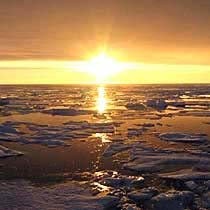
 slabs of ice before they reach the famed Shiretoko Peninsula. Hokkaidō, scene of this year's July G8 summit, is Japan's second largest island where tourists enjoy photographing and sometimes catching a quick ride on drifting blocks of ice. Within the past five years, drift ice is melting as it arrives in the Sea of Okhotsk. The sea between Russia and Japan freezes each winter into ice lily pads that ride the current to an isle, the World Heritage Site of Shiretoko. The lack of staying power for this ice deprives the area's ecosystem of necessary nutrients, temporary homes or safe havens for flocks of rare birds and imperils a vibrant tourism industry economic base for the area. In prior seasons, the frozen ice masses could last up to four months.(photo Tony McNicol)
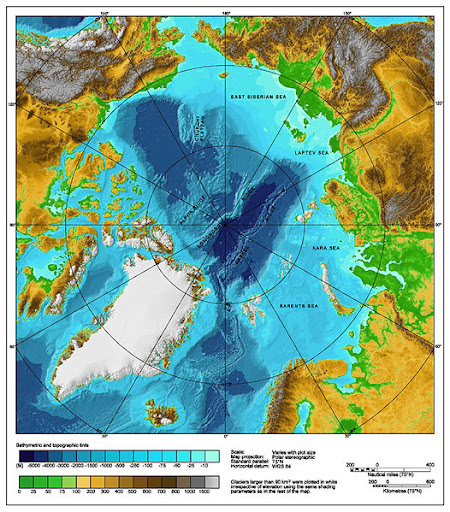
The pursuit of those resources will be underscored this week as the U.S. Coast Guard cutter Healy sails north from Barrow, Alaska, on Thursday to map the sea floor of the Chukchi Cap, an area at the northern edge of the Beaufort Sea. The maps could bolster U.S. claims to the area as part of its extended outer continental shelf.
The U.S. Geological Survey confirmed last month what the oil industry had long suspected when the agency released an estimate that the area north of the Arctic Circle may hold as much as 90 billion barrels of
oil and 1,669 trillion cubic feet of natural gas, or roughly 13 percent of the world's total undiscovered oil and 30 percent of the undiscovered natural gas.
The dash to stake out territory across the Arctic has accelerated since Russia sent one of its submarines last August to plant the country's flag on the sea floor beneath the North Pole, provoking an outcry by other nations that viewed it as an unauthorized land grab.
Earlier this month, Canadian officials at a geology conference in Norway detailed their territorial claims to the Lomonosov Ridge, an underseas mountain range that runs beneath the North Pole. Canada argues that the ridge is part of the North American continent, not part of Siberia, as Russia has asserted.
 The Northwest Passage is on its way to becoming open for shipping, more marine life, and international strife as the phony debate over drilling accelerates the years old diplomatic debate over the "true" Arctic owners (Russia, Canada, USA) of the natural resources presumably beneath the Arctic Ocean's floor. The USGS confirms collaboration between Canada and the USA on making a shared map while Russia disputes Canada's calim because their coastline borders more of the ocean.
Melting ice is causing trauma to the polar bear community as fishing becomes precarious, with sharks and killer whales following their prime blubber meal tickets, seals. One endangered polar bear suffered the indignity of being eaten by a Greenland shark off of Svalbard, home of the Noah's Ark of Seeds. Scientific arguments range from no way from the shark experts (except, the bone found in the shark's gullet proved it) to the Norwegian Polar Institute owning up to shock and theorizing that, maybe, the bear was already dead. The same slower shark species have also shown a taste for caribou in the past. Killer whales are expanding their northern Arctic territory in the colder waters while more sharks prefer warmer waters.
Redistribution of the drift ice and the loss of long standing hunting grounds portend more unsettling surprises as humankind and marine life adapt to climate changing events pushing economies and behaviors of all involved into the unknown.Jeffrey Gallant, the co-director of a Canadian-based shark research group, said: "There's no possibility a Greenland shark could predate a live adult white bear, unless it was injured or seriously ill."
He said the Greenland shark would not be able to afford the risk of injury, or the expenditure of energy needed to kill such a large and dangerous animal.
"There is far easier prey to be found," said Mr Gallant.
 Jeffrey Gallant, the co-director

Festivalgoers arrived riding bicycles or public transit and toting reusable food and drink containers. A special calculator will be used to find out how much emissions there were as a result of the festival, and carbon credits will be used to help offset the impact.
“We’re aiming for zero, but we could end up in the positive,” said Gauthier.

"Without the Rideau Canal, we would not be the capital of this country. It used to be the economic motor of this city. And if you've had a chance to cycle, walk or canoe along it, you know the active living side of it," he said.
For its part, Ottawa Tourism has been using the UNESCO designation "front and centre" in its marketing ventures, said spokeswoman Jantine Van Kregten.
"It's the crème de la crème of tourism. The most important and most significant social, cultural and educational places to visit. We're now on that very exclusive list," she said.
In anticipation of more international visitors, the Bytown Museum, located at the bottom of the locks where the canal meets the Ottawa River, has invested in an audio tour in six languages -- English, French, Spanish, German, Mandarin and Japanese.

So far, they have it exactly right.

 Mesmeric movements of schools of jellyfish are beautiful from a distance, but they are growing exponentially in number and stings in the warm southern waters off Mallorca, Spain in the Mediterranean Sea. In some cases, there are more than a dozen jellyfish per square meter. The coastal picture warps into shards of pain when an individual is stung accidentally trodding upon or splashing to close to the jellyfish. Spain's beautiful autonomous archipelago is among the lush places beckoning resort goers in the heat of the summer season. Mallorca, land of the beautiful serene beaches and teal seas, is staving off a bloom of jellyfish that is marauding from Nice to the Iberian coast from conditions that bespeak the ill health of our ocean systems. (Dani Cardona/Reuters)
“These jellyfish near shore are a message the sea is sending us saying, ‘Look how badly you are treating me,’ ” said Dr. Josep-María Gili, a leading jellyfish expert, who has studied them at the Institute of Marine Sciences of the Spanish National Research Council in Barcelona for more than 20 years.
The explosion of jellyfish populations, scientists say, reflects a combination of severe overfishing of natural predators, like tuna, sharks and swordfish; rising sea temperatures caused in part by global warming; and pollution that has depleted oxygen levels in coastal shallows.
These problems are pronounced in the Mediterranean, a sea bounded by more than a dozen countries that rely on it for business and pleasure. Left unchecked in the Mediterranean and elsewhere, these problems could make the swarms of jellyfish menacing coastlines a grim vision of seas to come.


Next year could be worse.
2 August, 2008
Subscribe to:
Posts (Atom)


