 La Dame Blanche belts out a siren song, luring top skiers and avid hikers in all seasons. Near Chamonix, France, ten were crushed to their deaths today buried beneath snow and boulders of ice in another massive summer avalanche ,while 8 others survived with two still missing and buried. Since 1 July, a climbing toll of twenty died in a summer season rife with peril on Mont Blanc. The Alps are suffering from declining snowfalls and mushier snowpacks setting up perfect conditions for a raging wind to push massive amounts of snow and glacial ice off the mountaintops. Ravages of global warming and climate change enhance the risks of tangling with Mont Blanc. Ski tourists follow the best powder. Mont Blanc with the highest elevation in western Europe, almost 16,000 feet or 4,811 meters, remains an irresistible challenge whether its summer or winter.

They were among a party of climbers who were hit by a wall of snow 200mAvalanches are majestic to watch. In the Alps, summer is a season for deadly avalanches. Seasoned people arm themselves with all types of devices like EPIRB or Personal Locating Beacons with GPS to get located quickly by dogs or authorities. But so many times they are merely there to locate the remains when avalanches make areas impassable or threaten further slides, endangering rescuers. On the European table 2 or small avalanches lists death as one of the range of outcomes in an unstable area.
(600ft) long and about 45m wide while roped together on Mont-Blanc du
Tacul.
The avalanche is believed to have happened at about 0300 (0100 GMT)
after a large block of glacier ice broke off higher up the mountain.
The group of climbers had been bivouaced on the slope below.
A climb to Mont Blanc du Tacul, part of the Mont Blanc massif, is done in well
 equipped stages. Both the Italians and the French have well traveled, for a glacier mountain, historic routes to follow across the mountain range. Passes are described as snow in the upper elevations or bridle path and road at the more modest or lower stages. There is always a veritable danger of avalanches as wind conditions shift and temperatures change. Reaching the summit where the Janssen Observatory once stood, is considered a pinnacle of the trip. Proposed as a World Heritage Site because its deemed where mountaineering originated with the official ascent of Jacques Balmat and Dr. Michel Paccard in 1786 would require Italy, France and Switzerland to make a joint application for the protection the listing would offer. Conserving the mountain range has more of a sense of urgency as glacier melts and increased tourist visits to the area are altering its ecosystem and the mountains features.


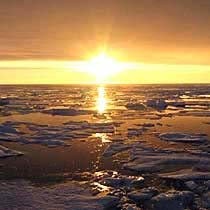
 slabs of ice before they reach the famed Shiretoko Peninsula. Hokkaidō, scene of this year's July G8 summit, is Japan's second largest island where tourists enjoy photographing and sometimes catching a quick ride on drifting blocks of ice. Within the past five years, drift ice is melting as it arrives in the Sea of Okhotsk. The sea between Russia and Japan freezes each winter into ice lily pads that ride the current to an isle, the World Heritage Site of Shiretoko. The lack of staying power for this ice deprives the area's ecosystem of necessary nutrients, temporary homes or safe havens for flocks of rare birds and imperils a vibrant tourism industry economic base for the area. In prior seasons, the frozen ice masses could last up to four months.(photo Tony McNicol)
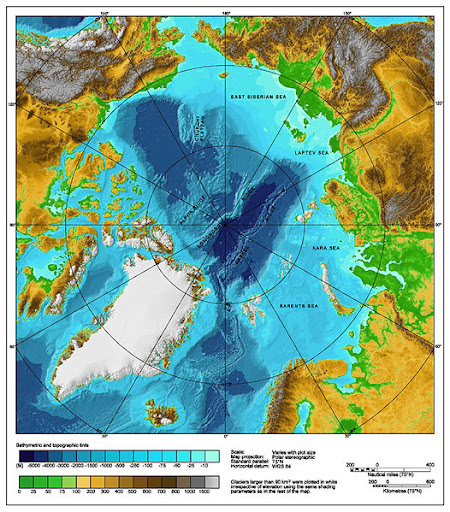
The pursuit of those resources will be underscored this week as the U.S. Coast Guard cutter Healy sails north from Barrow, Alaska, on Thursday to map the sea floor of the Chukchi Cap, an area at the northern edge of the Beaufort Sea. The maps could bolster U.S. claims to the area as part of its extended outer continental shelf.
The U.S. Geological Survey confirmed last month what the oil industry had long suspected when the agency released an estimate that the area north of the Arctic Circle may hold as much as 90 billion barrels of
oil and 1,669 trillion cubic feet of natural gas, or roughly 13 percent of the world's total undiscovered oil and 30 percent of the undiscovered natural gas.
The dash to stake out territory across the Arctic has accelerated since Russia sent one of its submarines last August to plant the country's flag on the sea floor beneath the North Pole, provoking an outcry by other nations that viewed it as an unauthorized land grab.
Earlier this month, Canadian officials at a geology conference in Norway detailed their territorial claims to the Lomonosov Ridge, an underseas mountain range that runs beneath the North Pole. Canada argues that the ridge is part of the North American continent, not part of Siberia, as Russia has asserted.
 The Northwest Passage is on its way to becoming open for shipping, more marine life, and international strife as the phony debate over drilling accelerates the years old diplomatic debate over the "true" Arctic owners (Russia, Canada, USA) of the natural resources presumably beneath the Arctic Ocean's floor. The USGS confirms collaboration between Canada and the USA on making a shared map while Russia disputes Canada's calim because their coastline borders more of the ocean.
Melting ice is causing trauma to the polar bear community as fishing becomes precarious, with sharks and killer whales following their prime blubber meal tickets, seals. One endangered polar bear suffered the indignity of being eaten by a Greenland shark off of Svalbard, home of the Noah's Ark of Seeds. Scientific arguments range from no way from the shark experts (except, the bone found in the shark's gullet proved it) to the Norwegian Polar Institute owning up to shock and theorizing that, maybe, the bear was already dead. The same slower shark species have also shown a taste for caribou in the past. Killer whales are expanding their northern Arctic territory in the colder waters while more sharks prefer warmer waters.
Redistribution of the drift ice and the loss of long standing hunting grounds portend more unsettling surprises as humankind and marine life adapt to climate changing events pushing economies and behaviors of all involved into the unknown.Jeffrey Gallant, the co-director of a Canadian-based shark research group, said: "There's no possibility a Greenland shark could predate a live adult white bear, unless it was injured or seriously ill."
He said the Greenland shark would not be able to afford the risk of injury, or the expenditure of energy needed to kill such a large and dangerous animal.
"There is far easier prey to be found," said Mr Gallant.
 Jeffrey Gallant, the co-director

Festivalgoers arrived riding bicycles or public transit and toting reusable food and drink containers. A special calculator will be used to find out how much emissions there were as a result of the festival, and carbon credits will be used to help offset the impact.
“We’re aiming for zero, but we could end up in the positive,” said Gauthier.

"Without the Rideau Canal, we would not be the capital of this country. It used to be the economic motor of this city. And if you've had a chance to cycle, walk or canoe along it, you know the active living side of it," he said.
For its part, Ottawa Tourism has been using the UNESCO designation "front and centre" in its marketing ventures, said spokeswoman Jantine Van Kregten.
"It's the crème de la crème of tourism. The most important and most significant social, cultural and educational places to visit. We're now on that very exclusive list," she said.
In anticipation of more international visitors, the Bytown Museum, located at the bottom of the locks where the canal meets the Ottawa River, has invested in an audio tour in six languages -- English, French, Spanish, German, Mandarin and Japanese.

So far, they have it exactly right.

 Mesmeric movements of schools of jellyfish are beautiful from a distance, but they are growing exponentially in number and stings in the warm southern waters off Mallorca, Spain in the Mediterranean Sea. In some cases, there are more than a dozen jellyfish per square meter. The coastal picture warps into shards of pain when an individual is stung accidentally trodding upon or splashing to close to the jellyfish. Spain's beautiful autonomous archipelago is among the lush places beckoning resort goers in the heat of the summer season. Mallorca, land of the beautiful serene beaches and teal seas, is staving off a bloom of jellyfish that is marauding from Nice to the Iberian coast from conditions that bespeak the ill health of our ocean systems. (Dani Cardona/Reuters)
“These jellyfish near shore are a message the sea is sending us saying, ‘Look how badly you are treating me,’ ” said Dr. Josep-María Gili, a leading jellyfish expert, who has studied them at the Institute of Marine Sciences of the Spanish National Research Council in Barcelona for more than 20 years.
The explosion of jellyfish populations, scientists say, reflects a combination of severe overfishing of natural predators, like tuna, sharks and swordfish; rising sea temperatures caused in part by global warming; and pollution that has depleted oxygen levels in coastal shallows.
These problems are pronounced in the Mediterranean, a sea bounded by more than a dozen countries that rely on it for business and pleasure. Left unchecked in the Mediterranean and elsewhere, these problems could make the swarms of jellyfish menacing coastlines a grim vision of seas to come.


Next year could be worse.
2 August, 2008
Subscribe to:
Posts (Atom)


