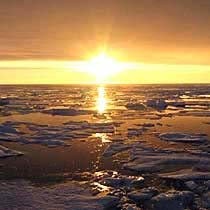
 slabs of ice before they reach the famed Shiretoko Peninsula. Hokkaidō, scene of this year's July G8 summit, is Japan's second largest island where tourists enjoy photographing and sometimes catching a quick ride on drifting blocks of ice. Within the past five years, drift ice is melting as it arrives in the Sea of Okhotsk. The sea between Russia and Japan freezes each winter into ice lily pads that ride the current to an isle, the World Heritage Site of Shiretoko. The lack of staying power for this ice deprives the area's ecosystem of necessary nutrients, temporary homes or safe havens for flocks of rare birds and imperils a vibrant tourism industry economic base for the area. In prior seasons, the frozen ice masses could last up to four months.(photo Tony McNicol)
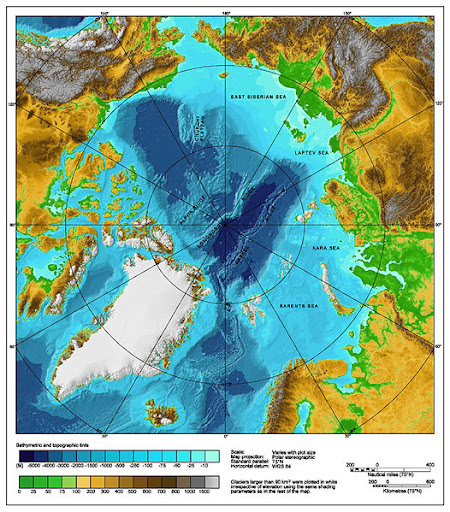
The pursuit of those resources will be underscored this week as the U.S. Coast Guard cutter Healy sails north from Barrow, Alaska, on Thursday to map the sea floor of the Chukchi Cap, an area at the northern edge of the Beaufort Sea. The maps could bolster U.S. claims to the area as part of its extended outer continental shelf.
The U.S. Geological Survey confirmed last month what the oil industry had long suspected when the agency released an estimate that the area north of the Arctic Circle may hold as much as 90 billion barrels of
oil and 1,669 trillion cubic feet of natural gas, or roughly 13 percent of the world's total undiscovered oil and 30 percent of the undiscovered natural gas.
The dash to stake out territory across the Arctic has accelerated since Russia sent one of its submarines last August to plant the country's flag on the sea floor beneath the North Pole, provoking an outcry by other nations that viewed it as an unauthorized land grab.
Earlier this month, Canadian officials at a geology conference in Norway detailed their territorial claims to the Lomonosov Ridge, an underseas mountain range that runs beneath the North Pole. Canada argues that the ridge is part of the North American continent, not part of Siberia, as Russia has asserted.
 The Northwest Passage is on its way to becoming open for shipping, more marine life, and international strife as the phony debate over drilling accelerates the years old diplomatic debate over the "true" Arctic owners (Russia, Canada, USA) of the natural resources presumably beneath the Arctic Ocean's floor. The USGS confirms collaboration between Canada and the USA on making a shared map while Russia disputes Canada's calim because their coastline borders more of the ocean.
Melting ice is causing trauma to the polar bear community as fishing becomes precarious, with sharks and killer whales following their prime blubber meal tickets, seals. One endangered polar bear suffered the indignity of being eaten by a Greenland shark off of Svalbard, home of the Noah's Ark of Seeds. Scientific arguments range from no way from the shark experts (except, the bone found in the shark's gullet proved it) to the Norwegian Polar Institute owning up to shock and theorizing that, maybe, the bear was already dead. The same slower shark species have also shown a taste for caribou in the past. Killer whales are expanding their northern Arctic territory in the colder waters while more sharks prefer warmer waters.
Redistribution of the drift ice and the loss of long standing hunting grounds portend more unsettling surprises as humankind and marine life adapt to climate changing events pushing economies and behaviors of all involved into the unknown.Jeffrey Gallant, the co-director of a Canadian-based shark research group, said: "There's no possibility a Greenland shark could predate a live adult white bear, unless it was injured or seriously ill."
He said the Greenland shark would not be able to afford the risk of injury, or the expenditure of energy needed to kill such a large and dangerous animal.
"There is far easier prey to be found," said Mr Gallant.
 Jeffrey Gallant, the co-director
 Lake Baikal not only contains 20% of the worlds fresh water, but being the deepest lake required two submersibles or mini-submarines to explore the bottom. This is a rare example that will not happen elsewhere on the planet. Certain Russians, held in high esteem by the current power elite within the Kremlin, were hoping to be in the Guiness Book of records with a dive that would reach depths of almost 1700 meters. Using the UNESCO World Heritage Site for a cheap Russian stunt to get a record while putting the veneer of science and Russian pride out front is not why the designation was earned in the first place. The waters, no ice, of 25 million year old Lake Baikal are relatively unspoiled with ample opportunity to study the ecosystem and find means of further conservation. The lake is often referred to as the Galapagos of Russia and yes, developers had thought a pipeline in the area in 2006 was a great idea.
The expedition was led by Artur Chilingarov, a pro-Kremlin member of parliament and Arctic explorer who led the submarine team that controversially planted a Russian flag on the sea bed below the North Pole last August.

Mr Chilingarov said just before the mission that the aim of the record-breaking attempt to reach the bottom of Lake Baikal was to preserve the unusual habitat of the lake, which was declared a Unesco World Heritage Site in 1996 because of its unique and rare wildlife.
The 18-tonne mini-submarines, Mir-1 and Mir-2, which already hold the world record for a manned dive in seawater, had to shed weight to make them less buoyant in freshwater. The mission went well even though Mr Chilingarov had anticipated difficulties. "There are technological problems, fickle weather conditions. Freshwater dictates special conditions," he had said before the expedition.


Subscribe to:
Posts (Atom)


